What is Your Hair Type?
Hair Type includes some of all of the following factors: Gemma Chua-Tran of Unsplash.com
Even though many people don't take cuticle health into consideration when evaluating their Hair Type, it definitely needs to be taken into consideration.
Cuticle Health: A healthy cuticle should look smooth and easily reflect light. It should also be able to withstand and limit friction when hair shafts are rubbed against each other. Generally, a healthy hair cuticle will be uniform in texture from the root to the tip of each strand.
Cuticle health can range from healthy to balanced and damaged.
Cuticle Form Or Shape: What are the three main cuticle patterns? There are three basic scale structures that make up the cuticlecoronal (crown-like), spinous (petal-like), and imbricate (flattened).
Combinations and variations of these types are possible. This is the shape the cuticle forms. Cuticle shape includes straight, wavy, curly, coily, and kinky.
Three Main Cuticle Shapes

Ana Itonishvili for Unsplash.com
What are the three main cuticle patterns?
Three basic scale structures make up the cuticlecoronal (crown-like), spinous (petal-like), and imbricate (flattened).
There are four types of hair patterns. Your hair follicle and hair shaft decide how your hair will look. The tilt of the hair follicle and the way it grows into the scalp determines your hair pattern.
This is the shape the cuticle forms. Cuticle shape includes straight, wavy, curly, coily, and kinky. Combinations and variations of these types are possible.
Straight
What is the rarest hair texture? According to anecdotal evidence, type 1A is the rarest hair type. It is generally seen in women of Asian ethnicity.
It typically lies flat from the roots to the tips. Its texture is soft and silky, and it is gleaming. It does not possess any curls. Often, women with straight hair have fine hair. Besides being soft, you can also see a high amount of oil secretion in this naturally straight hair type.
 Photo by Binh Ly on Unsplash
This hair type stays straight irrespective of any amount of curling. It typically lies flat from the roots to the tips.
Often, women with straight hair have fine hair. Its texture is soft and silky, and it is gleaming. It does not possess any curls. Besides being soft, you can also see a high amount of oil secretion in this naturally straight hair type.
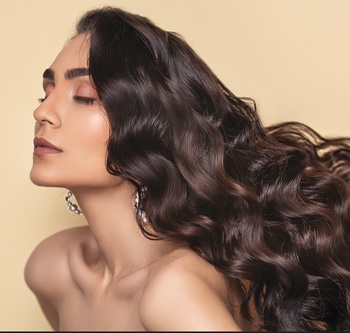
Wavy
- 2A tends to be thin wavy hair
- 2B is medium-wavy hair
- 2C is thick wavy hair
Can 2A - 2C hair become curly?
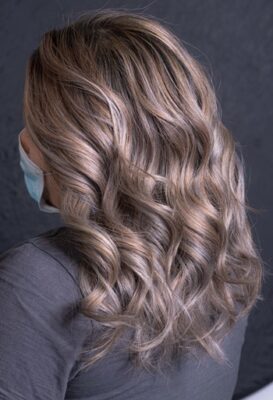
Valeriia Kogan on Unsplash.com
Yes, curly hair can be tighter with the help of a curling iron.
2A - 2C hair has a slightly wavy texture that can be worked into bouncy curls using the right heat styling tool. It's critical to remember that heat can always be damaging.
If hot tools are used to redefine natural curls, they should be used sparingly. Heat protection should always be applied first.
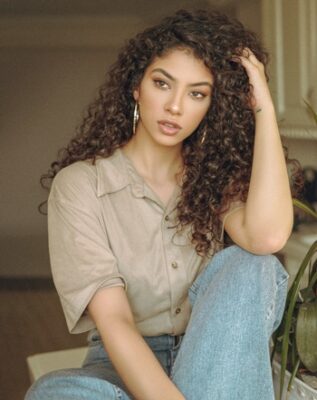
Curly Hair Ranges From Loose To Tight Curls
- 3A has loose curls
- 3B has loose to medium curls
- 3C has tight curls
Kinky Hair Each strand of kinky hair grows in a tiny, angle-like helix shape. The overall effect is such that, contrasted with straight, wavy, or curly hair, and kinky hair appears denser.
I
mage by Pouriya Kafaei - Unsplash
- 4A is very soft
- 4B tends to be wiry
- 4C is extremely wiry
- 4D - Also known as a Z pattern. The texture is cottony, with an extremely tight curl pattern resembling a Z shape, tight coils, or a blend of the two.
Not only that, but knowing your hair type allows you to choose the right hair products for your hair, like serums, shampoos, masks, and brushes. You can now create a hair care routine that nourishes and improves your hair type.
Follicle Density
Density: You can determine this by ponytail circumference. The number of strands of hair growing out of each square inch of your scalp. Hair density is generally highest at your vertex, the back of your head, or your crown. Thickness can range from low to medium or high.
Hair Elasticity
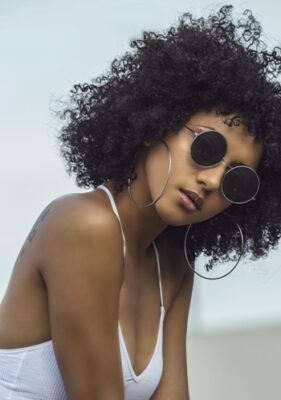 Tightly Coiled Kinks - Image by Justin Essah
Elasticity refers to the extent to which a single hair strand can stretch before returning to its normal state. Its a strong indicator of hair health. Hair with high elasticity has a healthy amount of shine and bounce. Its regarded as the strongest of all hair types. You can have high, medium, or low elasticity.
To find out what the elasticity of your hair is, wet a strand of hair and stretch it as much as possible. This will determine whether your hair falls under high, medium, or low elasticity.
If your hair strand stretches a long way without breaking immediately, it indicates high elasticity. This means stronger hair. Hair with high elasticity (when wet) can stretch up to 50% of its original length before it breaks. Often, coarse hair is highly elastic.
Medium Elasticity: If your hair stretches to some extent before breaking, it indicates medium elasticity. Most women have medium hair elasticity. You can strengthen your hair using natural hair masks and hair oils.
Low Elasticity: Hair that snaps almost immediately after stretching has low elasticity. This hair type tends to be limp and brittle. It requires special attention concerning the products used on it. Harsh chemicals can diminish hair elasticity. Hence, it is essential to choose shampoos that strengthen hair cuticles.
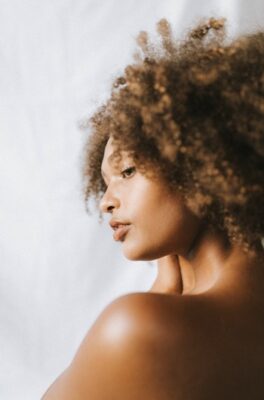 Kinky Hair - Huha Inc - Unsplash.com
Hair Porosity: Porosity measures the hair's ability to absorb and hold moisture. It can also be described as the indicator of how easily hydration can penetrate the hair. Hair porosity is primarily determined by genetics but can also be altered by external factors such as heat and chemical processing.
Oiliness
Follicle Oiliness: - Texture can affect how sebum works on the hair cuticle and shape. This involves follicle oiliness which can be dry, oily, a combination, or balanced.
Porosity
Hair porosity can be low, balanced, or high porosity.
- Low porosity: It usually takes a long time to dry without using a blow dryer or other heat sources. This hair type has difficulty absorbing hair care products.
- Balanced porosity: Generally easy to maintain and has a natural bounce. Additionally, it can be easily styled without using a large amount of product.
- High porosity: Tends to dry quickly. Moisture can leave the hair just as easily as it can be absorbed. It usually requires a large quantity of hair product and may occasionally fizz.
Scalp Health
 Ali Panzani - Unsplash
Scalp Health: Healthy hair starts with a healthy scalp. It can range from healthy to well-balanced or damaged.
Follicle Thickness
Hair Thickness: Hair with a small diameteror fine hairhas a typical diameter of about 50 microns. Strands with a larger diameteror coarse hairhave a typical diameter of about 120 microns. A piece of copy paper is 70 microns thick.
If you want to discover your hair thickness, take a piece of your hair. Hold it in between your fingers and rub them back and forth. If you don't feel anything, your hair type is considered fine.
Image by Pouriya Kafaei - Unsplash When you feel the hair in between your fingers, your hair type is medium.
However, if your hair feels thick in between your fingers, then your hair type is coarse.
Summary - What is Your Hair Type?
Decoding your hair type can be confusing. Not only might you have multiple cuticle shapes and type on the same head, but your scalp might also be oily and the ends of your follicles dry. Or vice versa.
There is no such thing as a normal hair type. Its impossible to make a generalistic statement about any type of hair because it depends on your Hair Type.
When it comes to hair, there is no one-size-fits-all formula. If you have any doubts about what categories your hair falls into, do more research or ask your hair professional for clarification.
Best wishes to all.