Alopecia areata (patchy) is the form with one or more coin-sized (usually round or oval) patches on the scalp or other places on the body that grow hair. This type may convert into either alopecia areata totalis. (hair loss across the entire scalp) or alopecia universalis (hair loss across the entire body). Most commonly, it remains patchy.
Persistent patchy alopecia areata
Persistent patchy alopecia areata is characterized by patchy scalp hair loss that continues over a long period of time without ever developing into extensive alopecia areata such as totalis or universalis.
Alopecia Totalis This results in hair loss across the entire scalp.
Alopecia Universalis This type of alopecia results in hair loss across the body. The rarest form of Areata Alopecia.
Other types of Alopecia Areta include, but are not limited to:
Ophiasis This type of Alopecia Areata refers to hair loss in the shape of a wave or a snake) at the circumference of the head. It has a unique pattern of hair loss, which includes the sides and lower back of the scalp (called the occipital region) in the shape of a band.
Ophiasis alopecia areata can be more difficult to treat because it does not respond as quickly to medication.
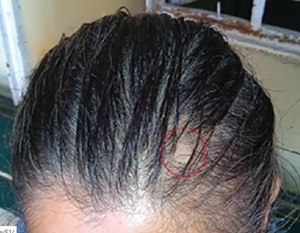 Alopecia areata monocularis - Alopecia Areata Monolocularis in Clozapine-induced Hypereosinophilia Shailesh Jha and Amit Khanna
Sisaipho- Alopecia areata (AA) sisaipho (ophiasis spelled backward) is an uncommon AA variant. AA Sisaipho has been scarcely described in the literature. It was first described by Muoz and Camacho in 1996.
It consists of scalp hair loss sparing the temporal and occipital areas, just the opposite of ophiasis. Some scientists use the terms ophiasis inversus and even anti-ophiasis; however, this could have negative connotations.
Mono And Multi Locularis
Monolocularis This is a rare type of alopecia areata that involves a single or mono patch of hair loss. Alopecia areata monolocularis is a variant called spot baldness.
This variant is usually the beginning phase of this autoimmune disease, or it may have eosinophilic peribulbar infiltrates.
Multilocularis- This type of alopecia areata usually affects a round patch of the scalp at first, then spreads in a centrifugal or multilocular pattern.
Alopecia Diffusa And Incognito
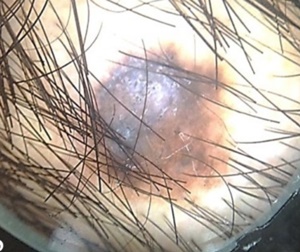 Dermoscopic image of the lesion shows an area of alopecia surrounding a melanocytic lesion, some exclamation mark hairs, and yellow dots. - https://pubmed.ncbi.nlm.nih.gov
 Perinevoid Alopecia: A Case Report - Len Felipe Ruiz-Arriaga 1 , Lirio Lpez-Garca 2 , Mara Elisa Vega-Memije
Alopecia Areata Diffusa - This condition results in sudden and unexpected thinning of the hair all over the scalp. It can be hard to diagnose because it looks a lot like other forms of hair loss, such as telogen effluvium or male or female pattern hair loss.
Alopecia Incognito - A rare form of alopecia areata occurs predominantly in young women. The typical patchy distribution of hair loss in classical alopecia areata is absent, but abrupt and intense hair loss is characteristic. This is similar to telogen effluvium.
Prognosis is generally more favorable, especially as compared to certain variants of alopecia areata, specifically alopecia areata totalis, universalis, and ophiasic areata.
More Rare Types Of Alopecia
Reticular Interconnecting Alopecia- A rare type of Alopecia Areata, which forms around branching interconnecting fine capillaries. It forms a band of lymphocytic infiltrate involving the interfollicular dermis and individual necrotic keratinocytes in the epidermis.
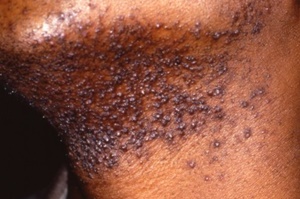 Picture of Pseudofolliculitis Barba - (PFB) from Madigan Army Medical Center Dermatology
Perinevoid (Around Nevi) Alopecia- Pigmented nevi (moles) are growths on the skin. They are usually flesh-colored, brown, or black. Alopecia Areata occurs around the central, pigmented nevi or moles. It forms a halo pattern.
Annular (Ring-like)- There is focal scalp alopecia in a circular pattern along the occipital scalp. The Halo scalp ring is a unique form of alopecia. It is usually non-scarring. It is associated with caput succedaneum or severe scalp edema at or shortly after birth.
It is more common in infants born to primigravid (first-time pregnancy) women.
Alopecia Areata Involving Men Only
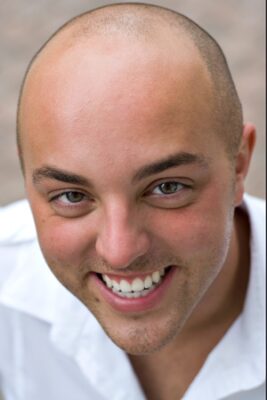 A smiling young man with shaved head. SBHB Image.
Alopecia Barbae - The disease may be limited only to the beard, which is called alopecia areata barbae. This disease doesnt just impact beard hair, it may also impact eyebrows or eyelashes.
The Takeaway
Hair is of both physiological and psychological importance. It protects against the suns ultraviolet rays. It also serves as a biological signaling function.
In many parts of the world, long and full womens hair is considered beautiful. It's a sign of youth. Thick pigmented mens hair signifies youth and vitality.
It's hardly surprising that people with excessive hair loss often seek medical help.
References
Perinevoid alopecia. An unusual variety of alopecia areata. Yesudian P, Thambiah AS. Arch Dermatol. 1976 Oct;112(10):1432-4. doi:10.1001/archderm.112.10.1432. PMID: 962338
Red Dots in a Net-Like Pattern on the Upper Chest: A Novel Clinical Observation in Frontal Fibrosing Alopecia
and Fibrosing Alopecia in Pattern Distribution
Victoria Billero,
* Kate E. Oberlin, and
Mariya Miteva